
Garage Floor Options in Connecticut: Epoxy Coating vs Paint, Sealer, Tile, and Mats
Epoxy coating, paint, sealer, tile, or mats: which garage floor option in Connecticut actually fits how you use the space? This comparison walks through what each choice handles well, where it falls short in a New England winter, and what to ask before you spend the money.
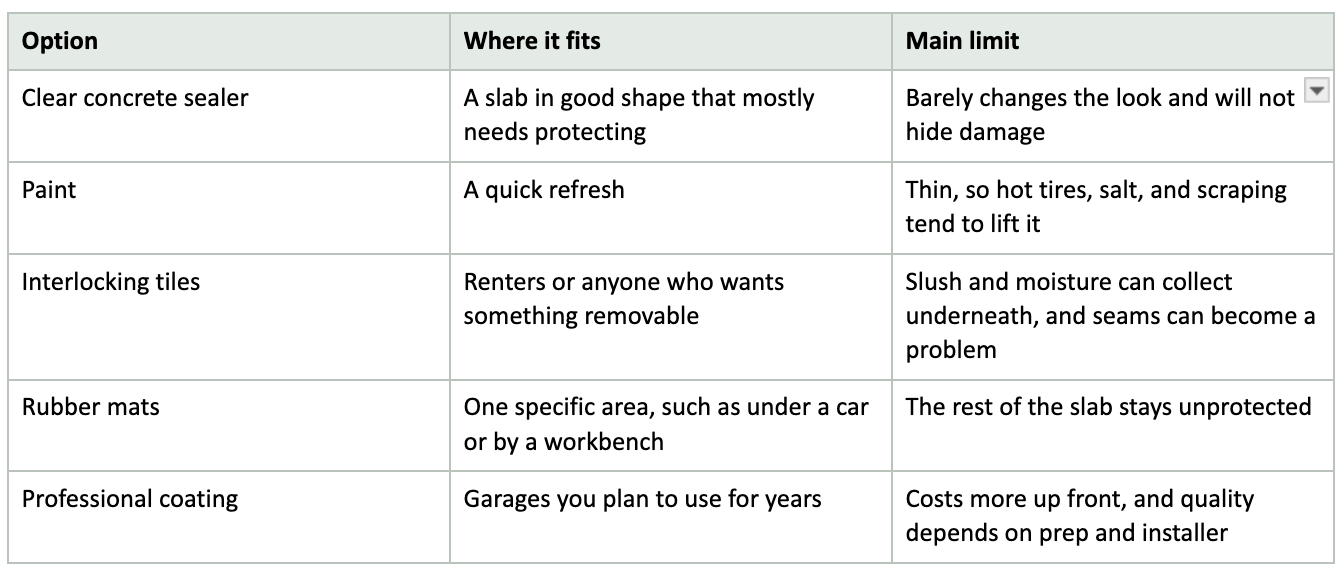
Garage floor options at a glance
Sealer and paint: the simple end
Start with what you want the floor to do. If it mostly needs protecting, the simple options may be enough. If it needs to look different or stand up to heavy use, they run out of room quickly.
A clear concrete sealer is the simplest and usually least expensive route. It soaks into or sits on the surface to help guard against moisture and stains, which suits a slab that is already in good shape. Paint is a quick way to freshen things up and can look good for a while, but many of the floors we see have a tired paint job that has to be ground off before anything else can go down. That is worth knowing if you are tempted to paint now and coat later.
Tiles and mats: removable, with tradeoffs
Tiles snap together without wet materials, which makes them attractive to renters. The downside is that moisture and salty slush can collect underneath, and in a busy garage the seams can become a problem. Mats are handy and simple for one area, but they leave the rest of the slab unprotected.
How a professionally installed coating differs
A coating bonds to prepared concrete and is made to resist stains, moisture, and traffic. The quality depends heavily on the prep and on the installer, which is why we keep returning to grinding, crack repair, and cleaning. It costs more up front and usually lasts longer than the alternatives, though how much longer depends on the slab and on how the garage is used.
What a Connecticut winter does to each choice
Salt and slush are the biggest test. They get dragged in on tires, melt off, and soak into the slab, and over time the surface wears away. A sealed and bonded floor handles that better than one with seams or a thin film, which is why road salt and concrete floors is one of the first things we talk about with homeowners.
Picture your actual routine: wet boots, salt crystals, slush, spilled windshield fluid, and the occasional oil drip. Sealer shrugs off some and absorbs others. Paint can bubble under hot tires, and tiles let slush work into the seams. A bonded coating keeps most of it on top of the floor where a mop can reach it.
Many owners think a coating is worth the extra cost for a garage they plan to use for years, but it depends on the condition of your slab and how you use the space. Flake and color finishes also change how the room looks, and some people care a great deal about that while others do not.
Questions to ask yourself and any installer.
Before choosing anything, ask yourself:
How long will you own the home?
How rough is the floor today? Damaged concrete needs repair whatever you pick.
What does the garage see, and how much cleaning are you willing to do?
Do you want to hide the concrete, or just protect it?
Then ask any installer what exactly goes on the floor layer by layer, how the concrete will be prepared, how it handles salt and hot tires, and what warranty is offered, what it covers, and whether you can see photos of finished floors. Prep matters more than the product name, and a company that welcomes these questions is usually one you can trust with the job.
Cost is where most comparisons end up. The cheapest route up front is not always the cheapest over a decade, since a sealer or paint job that needs redoing every couple of years eventually costs as much as a bonded coating. On the other hand, a coating you will never see the benefit of, in a garage you are about to sell, may not be the best use of your money. There is no universal answer, which is why we would rather look at your floor than recommend something sight unseen.
If you are still unsure, consider the rest of the home. A garage that is also your workshop, your gym, or your main entry into the house is asked to do more than one that only holds a car, and the more it is asked to do, the more a bonded floor tends to make sense. A garage that is mostly storage may be well served by something simpler.
Old paint that is failing has to be removed first, and that is true no matter which new surface goes on top. Many of the floors we see have a tired paint job that must be ground off before anything else can go down. It depends on how soon and on the condition of the slab. If you rent or plan to leave, mats or tiles can make a lot more sense.
Choosing your next step
If you want help comparing the options for your garage, Nutmeg Epoxy Floors serves Manchester, Hartford, Glastonbury, Vernon, East Hartford, South Windsor, Tolland, and nearby towns. See our garage floor epoxy page or request a free estimate and we will look at your floor and tell you what we would do.